
CS2 Float Values Explained: The Ultimate Guide
Everything you need to know about float values in CS2. Learn how floats affect skin appearance, pricing, trade-ups, and why they matter for collectors.
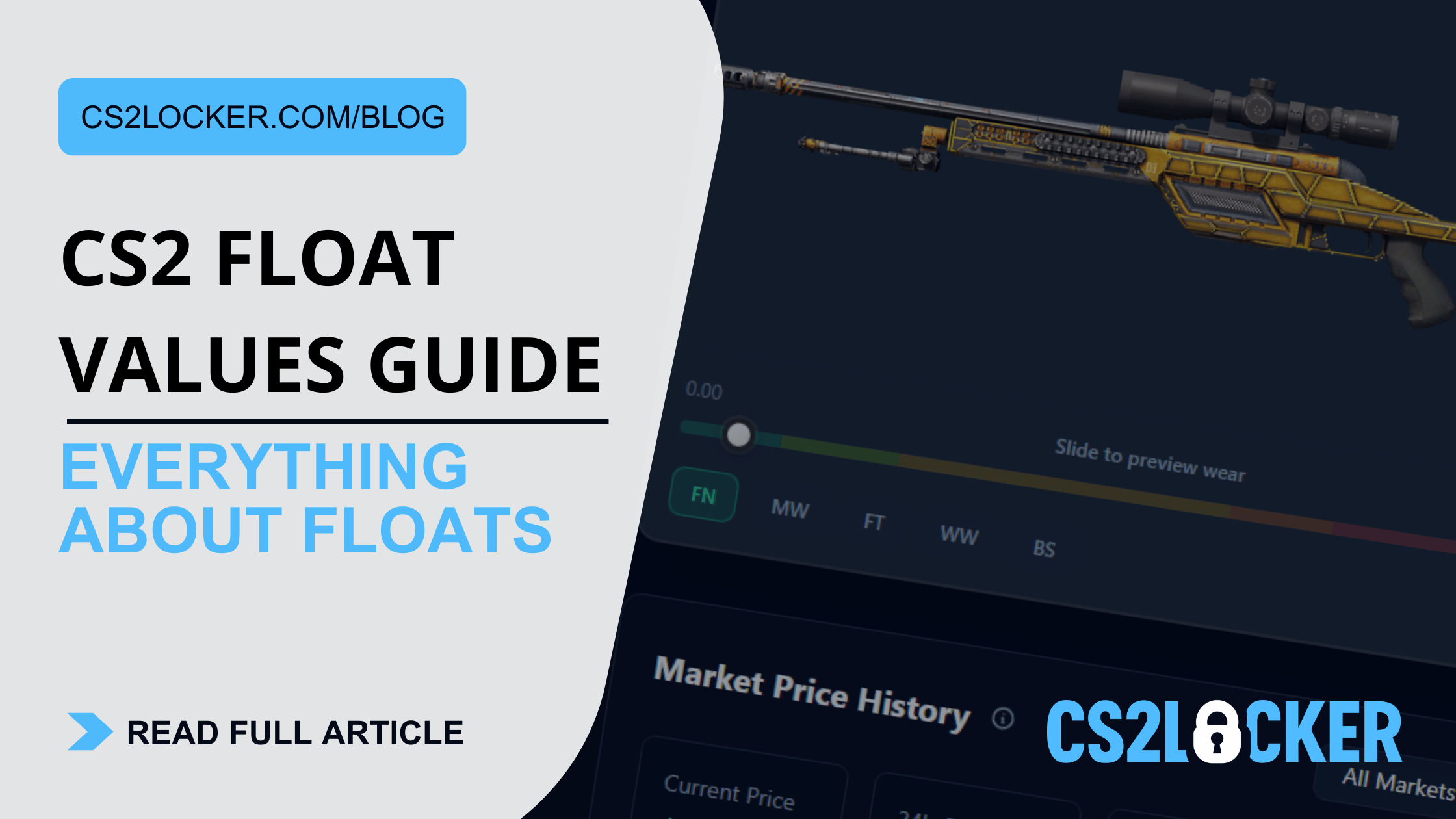
I once bought a skin listed as Factory New and it had visible scratches on it. That was my introduction to float values - the hard way. The listing was technically accurate; the skin was Factory New by condition label. But its float was sitting at 0.068, right at the edge of the FN range, which meant the wear was already pushing through. Once I understood what the number actually meant, I started reading every skin listing differently. This guide explains what float values are, why they matter far more than most players realize, and how they connect to trade-ups, pricing, and collecting.
Written by Rick
Founder & developer of CS2Locker - CS2 player and skin collector since 2015.
What Exactly is a Float Value?
Every weapon skin in CS2 carries a float value - a decimal number between 0 and 1 that determines its wear condition. This number is assigned the moment the skin is unboxed or produced from a trade-up, and it never changes. No matter how many times the skin gets traded, inspected, or transferred between accounts, the float stays fixed forever.
Lower floats mean less visible wear. A skin at 0.01 looks cleaner than the same skin at 0.06, even though both are technically Factory New. This distinction sounds minor until you realize the price difference between a 0.01 and a 0.06 FN can be hundreds of dollars on sought-after skins. The condition label tells you the tier. The float tells you the truth.
Float Ranges by Wear Condition
CS2 divides every skin into one of five wear conditions based on its float. These are the boundaries:
Factory New (FN): 0.00 - 0.07
Pristine condition - minimal to no visible wear. The most coveted and most expensive tier.
Minimal Wear (MW): 0.07 - 0.15
Slight wear that is often hard to distinguish from FN at a glance. Usually 20–40% cheaper than FN for the same skin.
Field-Tested (FT): 0.15 - 0.38
Moderate wear visible on many skins. The most common condition and often the best value for money.
Well-Worn (WW): 0.38 - 0.45
Significant wear. Often the worst value proposition - cheaper than FT but visibly worse.
Battle-Scarred (BS): 0.45 - 1.00
Heavy wear, scratches, and metal exposed. Usually the cheapest condition - though some skins actually look better or develop unique characteristics at extreme floats.
Why Float Values Matter
Visual Appearance
Float affects how your skin looks, but it does not affect every skin equally. An AK-47 Vulcan or AWP Asiimov changes dramatically between FN and FT - the crisp geometric lines blur and the colors dull. An AK-47 Redline, by contrast, looks nearly identical across all conditions because the dark metal design hides wear naturally. Before paying a condition premium, it's worth asking whether you will actually see the difference in-game. Some skins only show wear in areas that are barely visible during normal play, which makes paying for a better float a purely psychological purchase rather than a practical one.
Price Impact
The extremes are where float has the most dramatic effect on price. A 0.001 float Factory New on a popular skin can sell for two to ten times what an average 0.05 FN would fetch. The #1 lowest float of a particular skin is a collector's prize with its own premium detached from normal market logic. On the other end of the spectrum, the "Blackiimov" - an AWP Asiimov with a float above 0.95, where the scope turns completely black - is genuinely worth more than a typical Battle-Scarred version, simply because of how striking the transformation looks. These float extremes have their own active collector market.
Trade Up Calculations
In trade-ups, your input floats determine your output float through a fixed formula. This is one of the most powerful things you can understand as a trader - it means you can calculate your output condition before you commit to a trade-up, and deliberately choose inputs to aim for a specific float range. Getting a 0.00x FN out of a trade-up instead of a 0.06 FN can double or triple the value of your output on premium skins.
Skin-Specific Float Ranges
Not every skin can exist in every condition. Each skin has a fixed minimum and maximum float built into the game - that's why there is no Factory New AWP Asiimov anywhere in CS2. The skin literally cannot exist with a float below 0.18. Here are a few well-known examples:
| Skin | Min Float | Max Float | Note |
|---|---|---|---|
| AWP Asiimov | 0.18 | 1.00 | No FN exists |
| AK-47 Redline | 0.10 | 0.70 | No FN or BS |
| M4A4 Howl | 0.00 | 0.40 | No WW or BS |
| AWP Dragon Lore | 0.00 | 0.70 | No BS |
The Trade Up Float Formula
When you do a trade-up, the output float is calculated deterministically:
Output Float = (Average Input Float × (Max - Min)) + Min
The average input float is the sum of all 10 floats divided by 10. Min and Max are the output skin's fixed float boundaries. There is no randomness - you know exactly what you'll get before you commit. This is why float targeting is such a powerful strategy for anyone doing trade-ups with premium outputs.
Float Collecting - A Whole Subculture
There is a dedicated community of players who hunt for extreme floats the way others collect rare knives. Some chase the lowest possible float of a specific skin - a 0.0001 Karambit, say, or the lowest existing AK-47 Redline. Others aim for novelty floats: 0.420, 0.1337, 0.6969. The most serious collectors track world records and will pay significant premiums to own a #1 float item, with prices that have no connection to what the skin would sell for at a normal float. If you ever stumble across a skin with an extreme low float that you weren't planning to keep, it is worth checking whether it has collector value before you sell it for the standard market price.
How to Check Float Values
Floats are visible in-game when you hover over a skin in your inventory. Marketplaces like Buff163 and CSFloat display float values on every listing, which is one reason serious buyers prefer them over Steam Market - Steam does not show floats at all. CS2Locker's skin pages include float range data for each skin so you can understand what conditions are possible before you search.
Float as an Investment Consideration
Low float skins tend to appreciate more than high float ones over time, for a simple reason: supply contracts. As skins get traded up or accounts get abandoned, the total number of available copies decreases - and low floats are statistically rare to begin with. That rarity compounds over years. That said, not every low float deserves a premium. If the skin doesn't show meaningful visual difference at a better float, the collector market for it will be thin. Always check whether the visual impact actually justifies what you'd be paying before chasing a low float for its own sake. And when buying, always verify floats through trusted platforms - never take a seller's word for it.
Try Our Trade Up Calculator
Put this knowledge into practice with our free trade up calculator
Open Trade Up CalculatorRelated Articles
How to Avoid CS2 Scams: Complete Prevention Guide 2026
Protect your CS2 inventory from common scams. Learn about API key scams, phishing, impersonation, and more with our comprehensive safety guide.
guidesBest AK-47 Skins in CS2 Ranked (2026)
The definitive ranking of the best AK-47 skins in CS2. From budget picks under $5 to legendary Covert skins, find your perfect AK with live prices.
guidesBest Budget CS2 Skins in 2026
Build a great-looking CS2 loadout without breaking the bank. The best affordable skins across all weapon categories with live prices.